
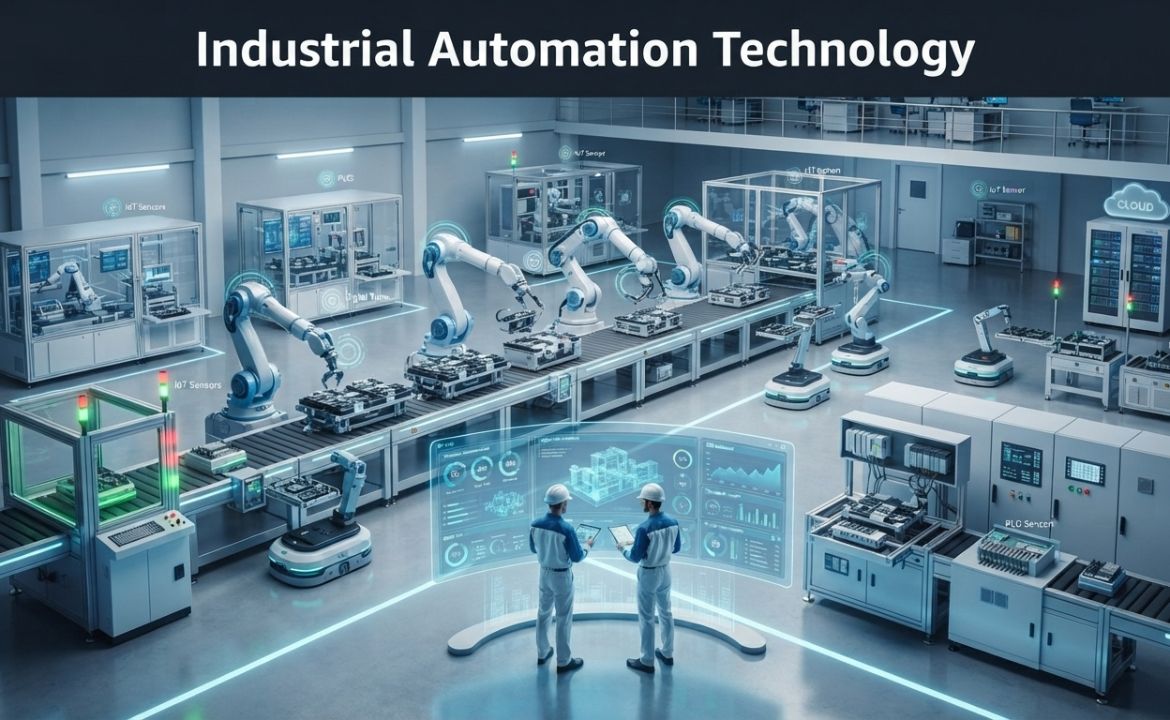
Industrial Automation Technology is revolutionizing manufacturing and commercial enterprise operations by using ways of converting manual strategies with smart machines, control systems, and virtual era. Industrial Automation Technology permits factories to decorate productivity, lessen operational expenses, enhance product awesomeness, and boom administrative center protection. By integrating robotics, programmable proper judgment controllers (PLCs), artificial intelligence, and the Internet of Things (IoT), industries can acquire faster production, actual time monitoring, and smarter desire-making.
Introduction to Industrial Automation Technology
Industrial automation technology refers to using computerized manipulate systems, software program application application, and machinery to perform commercial strategies with minimum human intervention.
It enables producers to optimize manufacturing, lessen errors, beautify performance, and keep normal products nice throughout numerous industries.
What Is Industrial Automation Technology?
Industrial Automation Technology combines mechanical engineering, electronics, computer structures, and software program software to automate manufacturing and organization operations.
Automation systems show devices, manage equipment, accumulate production information, and optimize workflows, permitting organizations to gain higher productivity and operational excellence.
How Industrial Automation Technology Works
Automation structures depend upon sensors, controllers, software software, and conversation networks to manipulate business systems.
Sensors collect real time records from machines, programmable common sense controllers technique the data, and automated systems execute obligations which consist of controlling automobiles, conveyor belts, robot palms, and manufacturing traces without regular human supervision.
Key Components of Industrial Automation Technology
Modern business automation structures consist of numerous critical additives.
These include:
- Programmable Logic Controllers (PLCs)
- Industrial robots
- Human-Machine Interfaces (HMIs)
- Supervisory Control and Data Acquisition (SCADA)
- Internet of Things (IoT) sensors
- Industrial manipulate structures
- Variable Frequency Drives (VFDs)
- Industrial verbal exchange networks
- Artificial Intelligence (AI)
- Cloud-based totally monitoring structures
These technology art work together to enhance performance, precision, and manufacturing reliability.
Programmable Logic Controllers (PLCs)
PLCs are the middle of many automation systems.
They gain input from sensors, machine programmed instructions, and manipulate devices which include cars, pumps, conveyors, and robot tools.
PLCs are acknowledged for his or her reliability, flexibility, and capability to feature in harsh industrial environments.
Industrial Robots
Industrial robots automate repetitive and excessive-precision responsibilities.
They are usually used for welding, assembly, packaging, painting, material handling, and high quality inspection.
Robotic structures decorate productivity at the identical time as lowering human publicity to dangerous environments.
Supervisory Control and Data Acquisition (SCADA)
SCADA systems allow operators to expose and control industrial approaches from centralized control rooms.
They collect actual time statistics, display device typical performance, generate alarms, and assist in the flung control of manufacturing facilities.
SCADA improves operational visibility and desire making.
Internet of Things (IoT)
IoT gadgets are a part of machines, sensors, and manufacturing machines through commercial employer networks.
Real-time tracking allows manufacturers to music device overall performance, energy consumption, manufacturing output, and preservation necessities.
IoT permits predictive maintenance and smarter manufacturing unit control.
Artificial Intelligence in Automation
Artificial Intelligence is enhancing commercial enterprise automation.
AI analyzes production information, detects machine screw ups, predicts maintenance goals, optimizes production schedules, and improves top notch control through device learning algorithms.
These skills assist producers lessen downtime and enhance overall performance.
Benefits of Industrial Automation Technology
Understanding Industrial Automation Technology turns into much less complex at the same time as examining its blessings.
Some of the vital blessings encompass:
- Increased production performance
- Improved product extremely good
- Reduced working charges
- Enhanced place of work protection
- Lower human errors
- Faster manufacturing cycles
- Better beneficial useful resource usage
- Predictive safety
- Real-time production tracking
- Higher traditional productivity
These advantages help industries stay competitive in international markets.
Applications Across Industries
Industrial Automation Technology helps many business sectors.
Common packages consist of car manufacturing, food and beverage processing, pharmaceuticals, chemical production, oil and gas, mining, logistics, electronics production, packaging, and strength era.
Automation improves consistency and operational usual overall performance during diverse industries.
Challenges of Industrial Automation
Although automation offers several advantages, organizations moreover face numerous disturbing situations.
High implementation expenses, device integration complexity, cybersecurity dangers, worker training necessities, and retaining superior devices require careful planning and ongoing funding.
Organizations need to moreover manage personnel transitions as automation expands.
Industry four. Zero and Smart Manufacturing
Industry four. Zero represents the subsequent technology of enterprise manufacturing.
It combines automation, IoT, synthetic intelligence, cloud computing, digital twins, and superior analytics to create practical factories able to make real time alternatives and continuously enhance operations.
Smart manufacturing will boom flexibility and responsiveness to marketplace wishes.
Future Trends in Industrial Automation
The future of automation will continue to focus on smart manufacturing.
Collaborative robots (robots), issue computing, 5G connectivity, AI powered great inspection, unbiased cell robots, virtual twins, and sustainable manufacturing generation are anticipated to shape the subsequent phase of industrial innovation.
These improvements will further decorate productivity and operational overall performance.
Why Industrial Automation Technology Matters
Industrial Automation Technology has turned out to be critical for organizations seeking out lengthy time period increase and competitiveness.
It permits manufacturers to provide great products extra efficiently while decreasing expenses, minimizing waste, and enhancing safety.
As industries grow to be more virtual, automation will remain a key cause of innovation and economic development.
Final Thoughts
Industrial Automation Technology is reworking cutting edge day-to-day manufacturing by means of the usage of integrating robotics, PLCs, artificial intelligence, IoT, SCADA structures, and cloud computing into commercial enterprise operations. These generations beautify overall performance, productivity, product superb, and administrative center safety whilst supporting smarter choice-making and predictive upkeep. As Industry four.Zero maintains to conform, Industrial Automation Technology will play an increasingly vital function in assisting businesses construct smart, connected, and notably green production environments.
FAQs
What is Industrial Automation Technology?
Industrial Automation Technology is the usage of automated manipulate systems, robotics, software program software, and virtual technology to perform company techniques with minimum human intervention.
What are the primary components of Industrial Automation Technology?
Key components include PLCs, business robots, SCADA structures, IoT sensors, HMIs, commercial enterprise communication networks, AI, cloud tracking systems, and manipulate software program software program.
What are the benefits of Industrial Automation Technology?
Major benefits embody higher productivity, stepped forward product brilliance, decrease running costs, greater workplace protection, predictive upkeep, and real-time manufacturing tracking.
Which industries use Industrial Automation Technology?
Automation is drastically utilized in car production, meals processing, prescribed drugs, electronics, oil and gasoline, mining, logistics, power, packaging, and chemical industries.
What is the destiny of Industrial Automation Technology?
The destiny consists of AI driven manufacturing, collaborative robots, digital twins, region computing, 5G enabled factories, impartial cell robots, and advanced clever production systems that boom efficiency and sustainability.